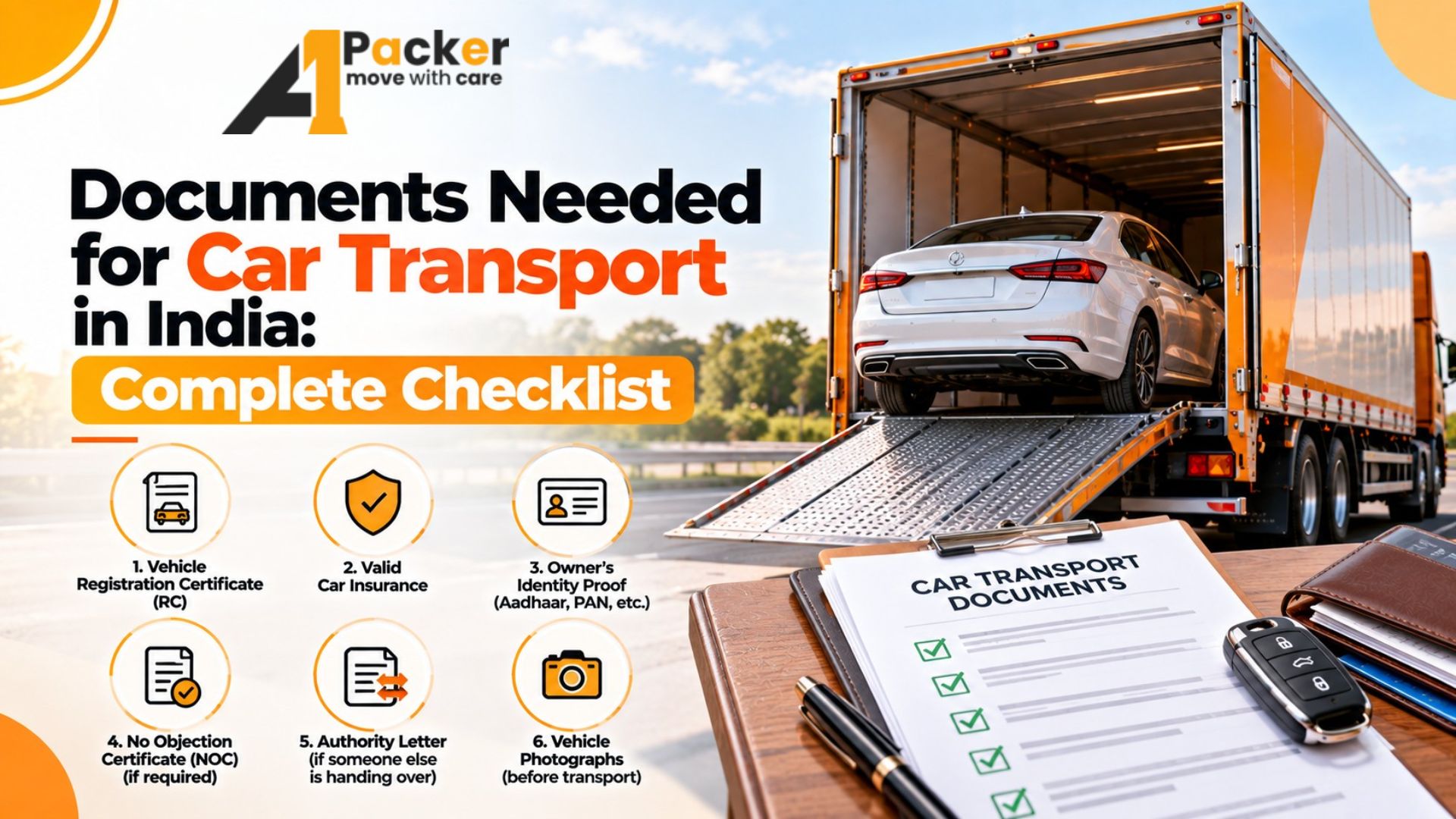
Why Documentation Matters in Car Transport
Car transport across Indian state borders involves checkpoints, inspections, and regulatory requirements that most private car owners have never encountered before. A missing document can delay your vehicle at a state border checkpoint for hours, or in the worst cases, result in the carrier being turned back. Understanding what paperwork is needed — and why — will ensure your car moves smoothly from pickup to delivery.
Document 1: Registration Certificate (RC)
The RC is the most important document for any vehicle on Indian roads. For transport purposes, the carrier needs a copy to show at border checkpoints and toll nakas to prove the vehicle is legally registered.
What to provide: A clear photocopy of both sides of the RC card. If your RC is in the old book format, provide a photocopy of the relevant pages.
Keep the original: Never send your original RC with the vehicle on the carrier. Keep it with you and travel with it separately. If the carrier is stopped and the original RC cannot be produced by the driver (who may not know you), this creates problems. Always send a notarised or self-attested photocopy with the carrier.
Name mismatch alert: If the RC is in someone else's name — a family member or the previous owner if you recently purchased the vehicle — inform your transport company in advance. They may require an additional authorisation letter from the registered owner.
Document 2: Valid Motor Insurance Certificate
An uninsured vehicle cannot legally be transported on public roads. The carrier's driver needs proof that the vehicle carries valid third-party or comprehensive insurance.
What to provide: A photocopy of your current motor insurance policy or the digital insurance certificate from your insurer's app.
Check the validity date: If your insurance is expiring within the next thirty days, renew it before transport. An expired insurance policy invalidates the entire transport process and leaves you without coverage if the vehicle is damaged in a road accident during transit.
Difference from transit insurance: Your motor insurance covers the vehicle on the road. It does not cover damage caused by the loading, unloading, or handling of the vehicle during transport. Transit insurance — a separate add-on offered by your transport company — covers exactly those risks. You need both.
Document 3: Your Government-Issued Photo ID
The transport company needs to verify your identity before accepting your vehicle. Acceptable ID documents include:
- Aadhaar Card
- PAN Card
- Driving Licence
- Passport
- Voter ID Card
Provide a photocopy for the company's records. In some cases, companies may ask you to be present at pickup and sign the handover receipt in person, for which your original ID will be checked.
Document 4: NOC for Vehicles Under Finance or Hypothecation
If your vehicle is under a loan and the RC shows the lender's name under "hypothecation" — which is standard for vehicles purchased on EMI — some states require a No Objection Certificate from the financing company before the vehicle can be moved across state lines.
This requirement varies by state. Ask your transport company specifically whether your vehicle's origin state and destination state require an NOC for hypothecated vehicles. If they do, contact your car loan provider well in advance — NOC processing can take three to seven working days at some banks.
Document 5: Authorisation Letter (If Not Moving Yourself)
If someone else — a family member, a colleague, or a representative — is handing over or receiving your vehicle on your behalf, the transport company will typically require a signed authorisation letter from you along with a copy of your ID.
The letter should state:
- Your name and ID details (as the registered owner or sender)
- The name and ID details of the person authorised to act on your behalf
- The vehicle's make, model, and registration number
- The nature of the authorisation (handover, or receipt, or both)
Document 6: Goods Receipt / Bilty
When your vehicle is handed over to the transport company, they will issue a Goods Receipt — also called a bilty or LR (Lorry Receipt). This document is your proof that the vehicle has been accepted for transport. It lists:
- The vehicle's registration number and description
- The condition at handover (any pre-existing damage noted)
- The origin and destination
- The estimated delivery date
- The declared value of the vehicle
This document is critical for any insurance claim. Keep it safely until after you have received and inspected the vehicle.
Pre-Transport Condition Report
While not a statutory document, the pre-transport condition report is the most practically important piece of paper in the entire process. Before loading, have a representative from the transport company walk around the vehicle with you, note every existing scratch, dent, and blemish, and sign the report. Both parties keep a copy.
If the vehicle arrives with new damage, the condition report is your evidence that the damage occurred during transport. Without it, establishing liability is significantly harder.
Summary Checklist
- Photocopy of RC (both sides)
- Photocopy of valid motor insurance certificate
- Photocopy of your government-issued photo ID
- NOC from financier if vehicle is under hypothecation (check if required for your route)
- Authorisation letter if someone else is handling handover or receipt
- Goods Receipt / Bilty at handover — keep until vehicle received
- Signed pre-transport condition report — keep until vehicle received
One Final Check
Before the carrier leaves, verify the driver has all the necessary documents for the vehicle in their possession. Ask to see the vehicle's document envelope and confirm the RC photocopy and insurance certificate are inside. A driver stopped at a state border with an incomplete document set is a problem you will be solving by phone from hundreds of kilometres away. Thirty seconds of verification at handover prevents that.