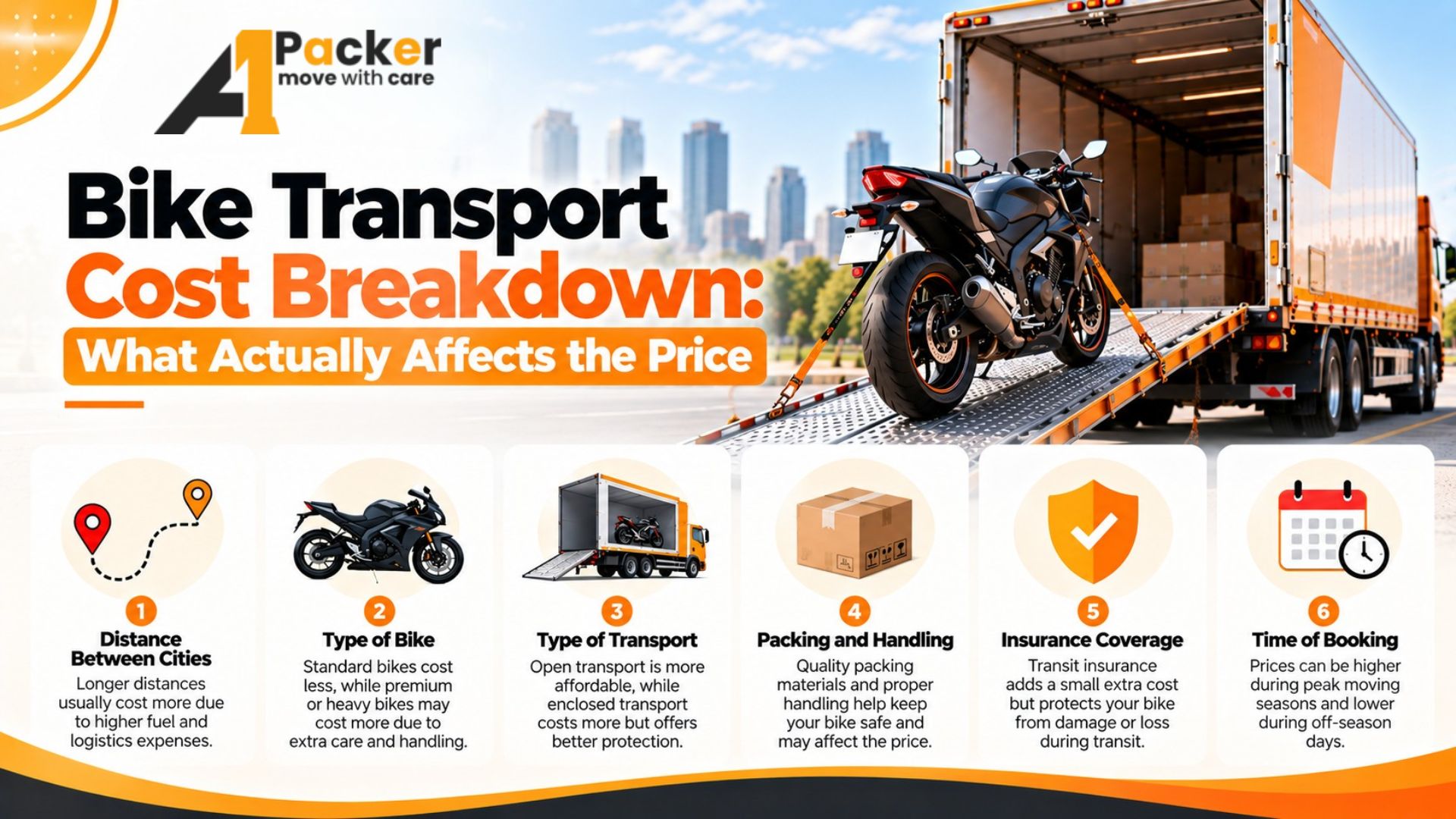
Why Bike Transport Quotes Vary So Much
You ask two companies how much it costs to transport your motorcycle from Delhi to Hyderabad and one says three thousand rupees while another says seven thousand. Both are quoting for the same bike on the same route. How can the prices be so different?
Bike transport pricing is built from several independent variables. Understanding each one helps you interpret any quote accurately, identify unrealistically low prices before they become problems, and negotiate fairly with a reputable company.
Factor 1: Distance
Distance is the primary driver of transport cost. Longer routes mean more fuel, more driver time, more road tolls, and more risk exposure over a longer journey. Most companies use broad distance brackets rather than exact per-kilometre pricing:
- Short distance (up to 500 km) — typically covers neighbouring states: Delhi to Jaipur, Mumbai to Pune, Bangalore to Chennai. Cost range: 1,500 to 3,500 rupees for a standard motorcycle.
- Medium distance (500 to 1,500 km) — covers routes like Delhi to Mumbai or Bangalore to Hyderabad. Cost range: 3,000 to 6,000 rupees.
- Long distance (1,500 km and above) — covers routes like Delhi to Bangalore, Delhi to Chennai, or northeast India routes. Cost range: 5,000 to 9,000 rupees.
These are indicative ranges for standard bikes without insurance. Actual quotes will vary based on the additional factors below.
Factor 2: Type and Size of the Bike
Not all bikes are the same size or weight, and transport pricing reflects this.
- Standard commuter motorcycles (100–150cc bikes like the Splendor, Shine, or Pulsar 150) — lightest category, lowest pricing tier
- Mid-range motorcycles (150–300cc bikes like the Apache, Bullet 350, or Bajaj Dominar) — slightly higher due to weight and size
- Performance and premium motorcycles (above 300cc — Royal Enfield 650, KTM Duke, Honda CB500) — higher pricing due to weight, size, and additional handling care required
- Scooters and mopeds — typically priced similarly to commuter motorcycles or slightly lower due to their compact size
A superbike or imported performance motorcycle may be quoted separately with specific handling requirements and a custom price — this is normal and appropriate given the vehicle's value.
Factor 3: Transport Method
Bikes are transported in two ways, and the method significantly affects cost:
- Shared carrier — your bike travels on a truck with several other two-wheelers. This is the standard, lower-cost method. The bike is loaded on a multi-bike carrier, secured with straps, and transported alongside bikes belonging to other customers on the same route.
- Dedicated transport — your bike is the only vehicle on the carrier, or it travels inside an enclosed single-vehicle transport. This is significantly more expensive but offers complete control over handling and timing.
For standard everyday bikes, shared transport is perfectly adequate. For expensive, rare, or heavily customised motorcycles, dedicated or enclosed transport is worth the premium.
Factor 4: Packing Method
Most transport companies offer two packing levels for bikes:
- Basic packing — protective wrapping around mirrors, handles, and exposed chrome parts. Included in standard quotes.
- Full wooden crating — the bike is placed inside a custom wooden crate that provides total protection from impact, scratches, and weather. Required for premium bikes travelling long distances or via routes with rough roads. Adds 500 to 1,500 rupees to the quote.
Factor 5: Transit Insurance
Transit insurance is the most important add-on and the one most commonly left out of initial quotes to keep the headline number low. It covers accidental damage or total loss of the bike during transport.
The premium is typically 1 to 3 percent of the bike's declared value. For a bike worth one lakh rupees, insurance costs between 1,000 and 3,000 rupees for the transport duration. This is not optional for any bike worth more than its transport cost — always add it.
Ask specifically: "What is the coverage limit?" and "What is the claims process?" A policy that covers only five thousand rupees on a one-lakh-rupee bike is not meaningful insurance.
Factor 6: Pickup and Delivery Type
Most companies offer two service levels:
- Door-to-door — the company collects the bike from your home and delivers it to the destination address. This is more convenient and typically costs 500 to 1,000 rupees more than depot-to-depot.
- Depot-to-depot — you drop the bike at the company's origin depot and collect it from their destination depot. Lower cost, but requires your time and a way to get to and from the depots.
Factor 7: Seasonality and Urgency
Demand for bike transport rises sharply during peak relocation seasons — April to June when transfers happen, and October to December when people relocate before festivals. During these periods, prices for available capacity rise. If your move is flexible, avoiding peak weeks can save 10 to 20 percent on the quote.
Express or guaranteed delivery dates — where the company commits to a specific delivery day rather than a window — also carry a premium. Standard delivery windows are typically three to seven days; express delivery narrows this to one to three days at a higher cost.
A Fair Quote Includes All of This
When you receive a bike transport quote, check that it specifies the transport method, packing level, insurance (or clearly states it is excluded), and pickup/delivery type. A quote that is simply "3,500 rupees to deliver your bike to Hyderabad" without further detail is not a complete quote. Ask for the breakdown before you confirm the booking.