Why Moving Day Is Harder with Children
Moving house is one of the top five most stressful life events for adults. For children, who have no control over the process, less context for why it is happening, and a deeper attachment to the physical space they call home, it can feel overwhelming.
The practical problem for parents is that stressed children on moving day create a compounding challenge: they need more attention precisely when you have the least to give. They get underfoot near the movers, they ask the same question repeatedly, and their distress adds to an already demanding day.
With some preparation and a few deliberate choices on the day itself, moving day with children can be manageable — sometimes even good. Here is how.
Before Moving Day: Involve Children in the Process
Children cope better with change when they feel like participants rather than passengers. In the weeks before the move:
- Tell them early — do not surprise children with moving day. Give them time to process the news, ask questions, and say goodbye to their current home and neighbourhood.
- Show them the new home — if possible, take them to see the new house or flat before moving day. Let them choose which room is theirs, or at least which wall their bed goes against. A child who has seen the new home treats moving day as a journey toward something rather than a loss of something.
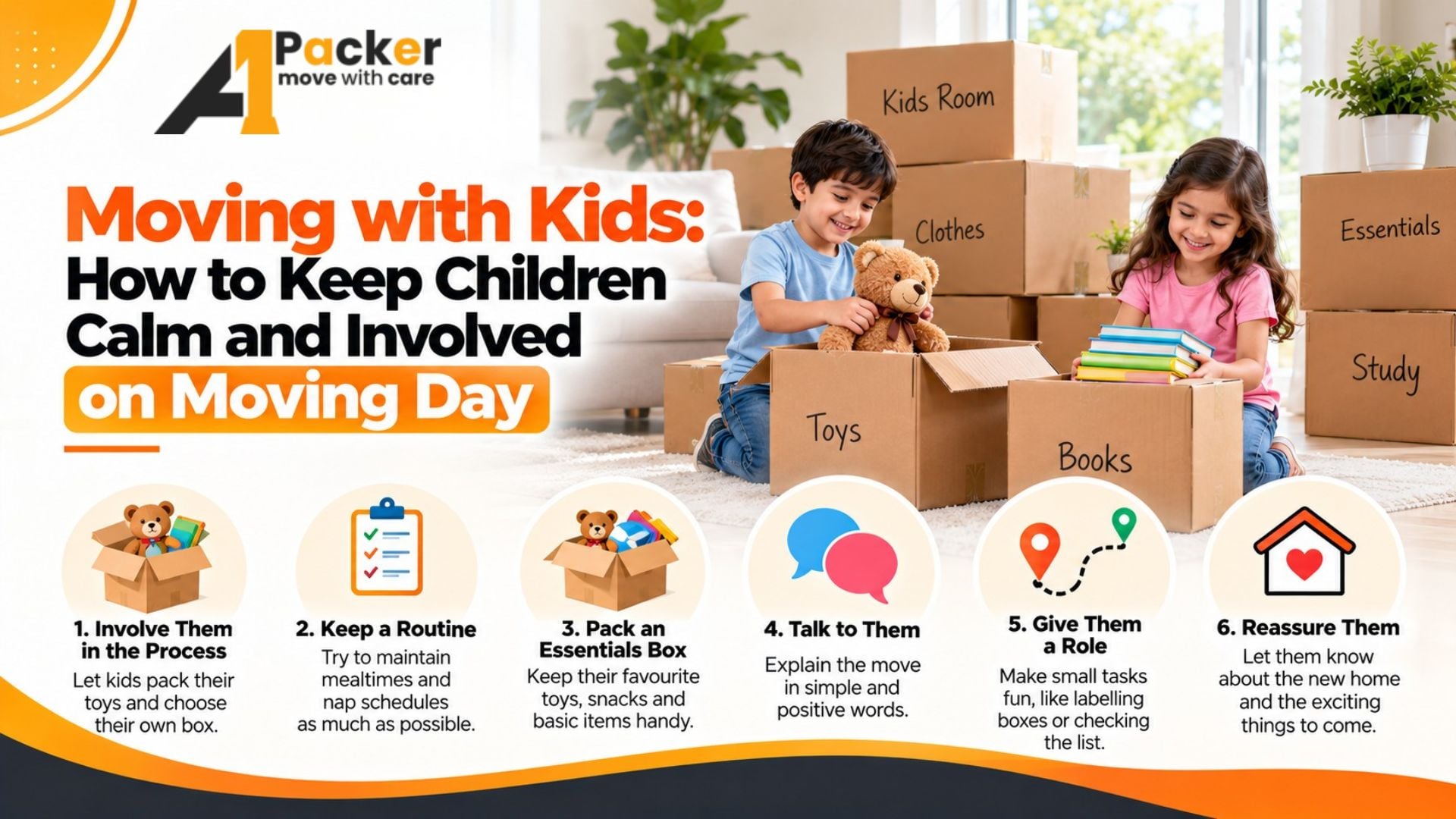
- Let them pack their own things — give each child a box or bag that is entirely theirs to pack. Their books, toys, art supplies, and treasured objects. This box is the last to leave and the first to be unpacked at the new home.
On Moving Day: Create Structure for the Kids
Designate a "Kids Zone" in the Old Home
Before the movers arrive, set aside one room or one corner of a room as the children's space for the day. Their bags, their snacks, and their activities go there. This area is not packed until the very end, and movers are asked not to enter it without a parent present.
This achieves two things: the children have a safe, familiar corner to return to throughout a chaotic day, and they are away from the main packing and loading activity, which reduces the risk of accidents near heavy furniture and moving equipment.
Assign Age-Appropriate Jobs
Children who feel useful are far calmer than children who feel in the way. Give each child a real, specific job:
- Ages 3–5 — carry their own small backpack of personal items to the car; help sort toys into "keep" and "donate" piles
- Ages 6–9 — label their own boxes with the room name; carry lightweight items like pillows and soft toys; be responsible for the family pet's bag
- Ages 10 and above — maintain the snack bag for the family throughout the day; cross items off a checklist as rooms are cleared; photograph each room before it is fully cleared as a memory activity
Even a largely symbolic job gives a child agency in the process. A six-year-old who has been given "the important job of holding the spare house key" takes that responsibility seriously and feels valued.
Keep the Day's Structure Predictable
Moving days are unpredictable for adults, but children need to know what comes next. Before the day starts, walk through the broad sequence with your kids: "First the movers come and load the truck. Then we clean the flat. Then we drive to the new home. Then we order pizza." Having a narrative to follow — even a loose one — reduces anxiety.
Stick to normal meal times as much as possible. Hunger amplifies stress in children significantly. Keep easy-to-eat snacks within reach all day, and do not let the chaos of moving day push lunch past 1 PM.
Consider Alternative Arrangements for Very Young Children
For children under three, moving day is genuinely more than they can process helpfully. If you have the option of having a grandparent, close friend, or trusted caregiver take a toddler or infant for the day — or even just for the morning — take it. The packing and loading period is the most intensive part of moving day, and a toddler at a loading site is both at risk and a source of significant distraction.
This is not abandoning your child to the experience. It is protecting them from the most overwhelming part of it and reuniting them at the new home when there is something positive to show them.
At the New Home: Unpack Their Room First
The single most effective thing you can do to help children settle into a new home is to unpack their room before anything else. Their bed, their bedside lamp, their books and toys in roughly the same configuration as before — this creates an island of familiar in an unfamiliar house.
Children who sleep in a recognisable room on the first night settle into the new home weeks faster than children who sleep amid boxes in a barely assembled space. This one act is worth the hour it takes to prioritise it above your own unpacking.
The First Week: Build New Routines Quickly
Within the first week, try to re-establish the routines that anchor children's days: the walk to the nearby park, the evening meal at the regular time, the bedtime reading. Familiar rhythms in an unfamiliar place communicate that the important things have not changed — only the scenery has.