Why Transit Time Is Harder to Predict Than You Think
Car transport timelines in India are influenced by far more variables than simple distance. A carrier that takes three days on a route in November might take five days on the same route in July, when monsoon roads, interstate checkpoints, and seasonal traffic all add time to the journey.
Understanding the factors behind transit time — and how to plan realistically around them — will help you coordinate your car's arrival with your own relocation timeline and avoid the frustration of waiting longer than expected.
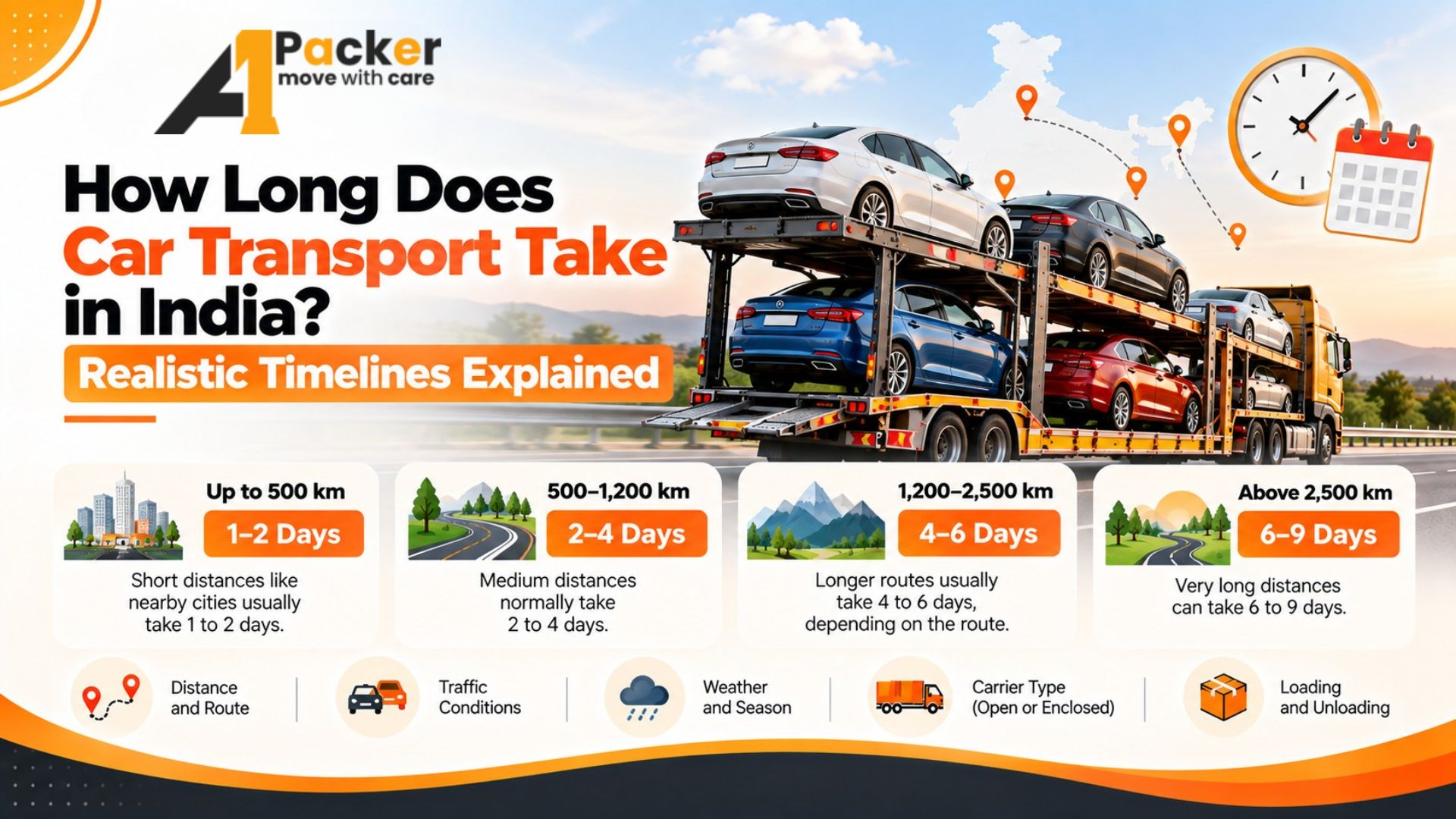
General Transit Time by Distance
These are realistic estimates based on standard road transport conditions in India. They represent the time from the carrier leaving the pickup point to delivery at the destination — not from booking to delivery, which includes loading schedule time discussed below.
Short Distance: Up to 500 km
Routes: Delhi to Jaipur, Mumbai to Pune, Bangalore to Mysore, Hyderabad to Vijayawada
Typical transit time: 1 to 2 days
On these shorter routes, a multi-car carrier completes the journey in a single driving day. Delivery is usually scheduled for the day after pickup, with morning delivery windows common for next-day service.
Medium Distance: 500 to 1,200 km
Routes: Delhi to Mumbai, Bangalore to Chennai, Hyderabad to Mumbai, Kolkata to Bhubaneswar
Typical transit time: 2 to 4 days
These routes cross one or more state borders and require overnight driving. A two-driver system on modern carriers can cover these distances in two days; older carriers with rest regulations may take three to four days.
Long Distance: 1,200 to 2,500 km
Routes: Delhi to Bangalore, Delhi to Chennai, Mumbai to Kolkata, Delhi to Kochi
Typical transit time: 4 to 6 days
Long-distance routes cross multiple states, may involve NH transfers, and require extended driver time. Plan for five days as your working estimate and treat four days as the optimistic scenario.
Very Long Distance: Above 2,500 km
Routes: Delhi to Kanyakumari, Mumbai to Guwahati, Northeast India routes
Typical transit time: 6 to 9 days
These routes involve remote roads, multiple state border crossings, and in some cases ferry crossings or mountain routes. Always use the upper end of any estimate for planning purposes.
The Difference Between Booking Time and Transit Time
Many customers confuse transit time with total time from booking to delivery. They are different:
- Booking to pickup — most standard car transport services operate on a 24 to 72 hour pickup window after booking confirmation. Immediate pickup can sometimes be arranged at a premium.
- Loading consolidation — multi-car carriers often wait until they have enough vehicles loaded for a route before departing. This can add one to two days to the overall timeline.
- Transit time — the actual driving time, as described above
- Destination unloading — if a carrier serves multiple delivery points on the same route, your car may wait on the truck while other vehicles are delivered first. This can add a few hours to half a day.
Total time from booking to receiving your car is typically two to three days longer than the transit time alone. Book accordingly.
Common Causes of Delay
State Border Checkpoints
Interstate commercial vehicle checkpoints in India can add significant time to a journey, especially if documentation is incomplete or the checkpoint is busy. Delays of two to four hours at a single checkpoint are not uncommon during peak commercial traffic hours. Well-run transport companies with complete documentation typically move through faster.
Monsoon Season (June to September)
Heavy rains slow highway speeds, cause road closures on vulnerable routes, and increase the risk of landslides on ghat sections. Carriers running through coastal regions, the Western Ghats, or Northeast India during monsoon months should be assumed to take 20 to 30 percent longer than dry-season estimates.
Festival and Holiday Traffic
Around major national holidays — Diwali, Holi, Dussehra, Eid — highway traffic increases dramatically. Carriers moving during these windows take longer. If your relocation falls near a major festival, either book early to secure a pre-festival slot or plan for extended transit time.
Mechanical or Driver Issues
A breakdown on a loaded multi-car carrier requires a replacement vehicle before transit can resume. Most professional companies have contingency protocols for this, but it can still add one to two days to the timeline. Ask your transport company what their breakdown protocol is before booking.
How to Plan Around Transit Time
Do not plan for your car to arrive on the same day you do. The safest approach:
- Book car transport a few days before your household move if possible, so the car has already started its journey when your household goods depart
- Plan to use public transport or a rental car for the first two to three days at your destination
- Confirm estimated delivery date with your transporter 24 hours before the expected arrival and again when the carrier is within a few hours of your destination
A car that arrives two days after you is a minor inconvenience. A car that you scheduled to arrive the same day as you, and did not, is a real problem. Build the buffer in from the start.